
Making Stress Positive
Research Note

I came across this and thought it was worth sharing because a lot of my current work in buisness is focused dealing with pressure.
The Belief That Changes Your Biology
What a Stanford psychologist discovered about stress — and what she missed
The Evolutionary Journal — Richard Barrett
Alia Crum is a psychologist at Stanford who has spent fifteen years studying stress. Her findings are striking enough to be worth taking seriously — and incomplete enough to be worth extending.
Her central claim is this: it is not stress that harms you. It is what you believe about stress.
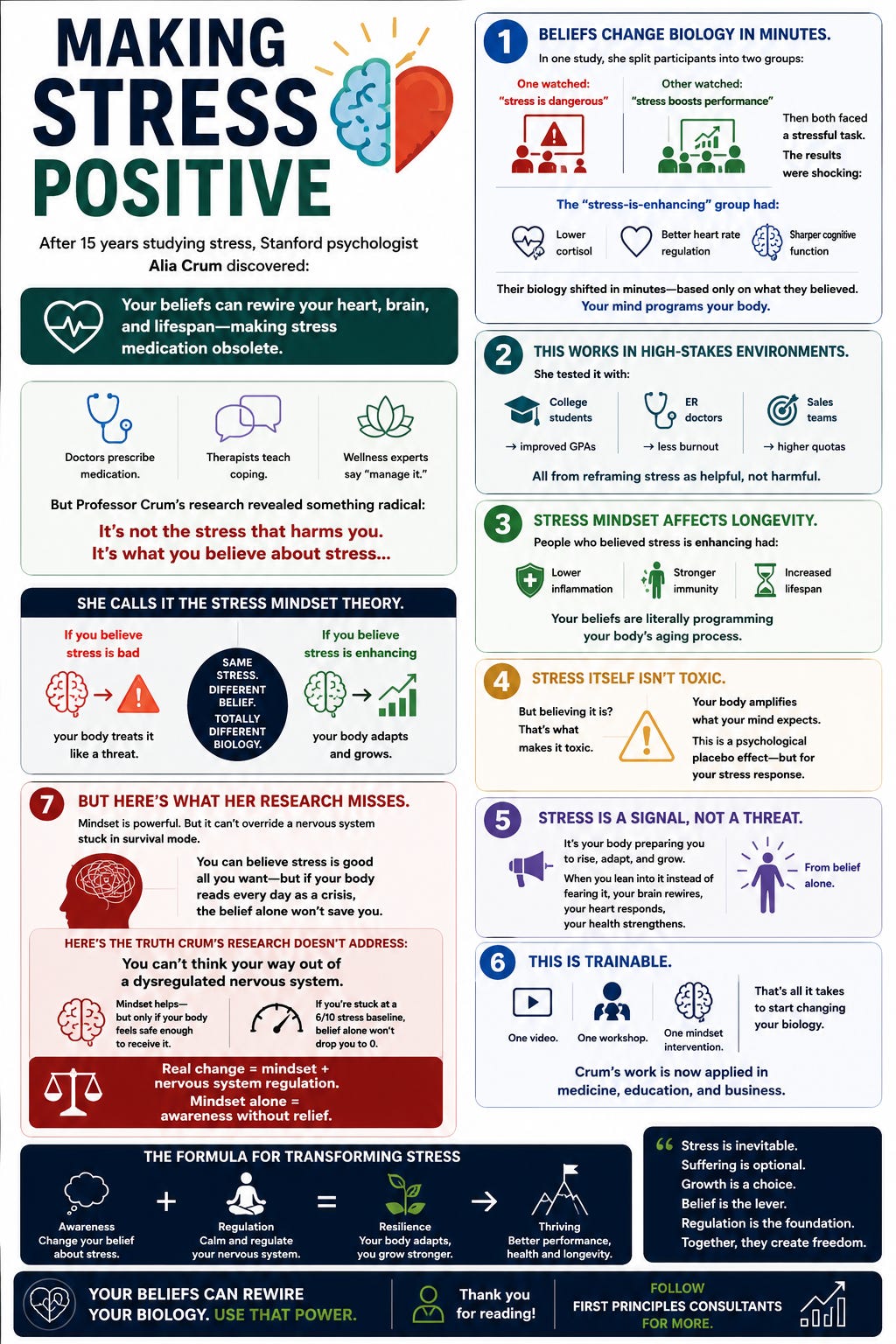
In a now-famous study, she divided participants into two groups. One group watched a short film framing stress as dangerous — corrosive to health, degrading to performance. The other watched a film framing stress as enhancing — a biological signal that the body is preparing to rise, adapt and grow. Both groups then faced the same objectively stressful task. The physiological results were different. The group that had been primed to see stress as enhancing showed lower cortisol, better heart rate regulation and sharper cognitive function — and their biology shifted in minutes, based solely on what they believed.
She replicated this across college students, emergency room doctors and sales teams. The pattern held. Reframing stress as helpful rather than harmful improved academic performance, reduced burnout and raised sales results. The practical implication she draws is significant: stress mindset is trainable, and even a single intervention — one video, one workshop, one reframe — can begin to shift the biology.
This is genuinely important research. But it stops at precisely the point where the most developmental work begins.
What the research gets right
Crum’s work confirms something that any serious understanding of the nervous system already implies: the body amplifies what the mind expects. This is not metaphor. The stress response is not simply triggered by external conditions — it is co-constructed by the meaning the organism assigns to those conditions. Two leaders facing the same difficult conversation will generate different biological responses depending on whether they interpret the conversation as a threat to be survived or a challenge to be navigated.
The mechanism is real. Beliefs change biology. The mind programs the body. Your nervous system is not a passive recorder of events — it is an active interpreter of them, and what it interprets shapes what it produces.
This is why the cognitive reframe matters. If you hold the belief that the activation you feel when stakes are high is your body preparing you — marshalling resources, sharpening perception, increasing the energy available for response — then that activation becomes a resource rather than a warning signal. The same physiological state that produces anxiety when labelled threat produces engagement when labelled challenge. The label is not merely psychological. It is, as Crum’s research shows, genuinely biological.
Point 5 in the infographic is the sharpest formulation: stress is a signal, not a threat. When you lean into it rather than fear it, your heart responds differently, your health strengthens, your longevity improves. Your beliefs are literally programming your body’s ageing process. This is not wellness marketing. It is documented physiology.
Where the research stops short
Here is what the infographic acknowledges — quietly, in section 7 — but does not fully develop.
Mindset is powerful. But it cannot override a nervous system that is stuck in survival mode.
You can believe that stress is enhancing all you want. If your body is already reading everyday life as a chronic low-grade crisis — if your baseline nervous system activation is running at a 6 out of 10 before any specific stressor arrives — the belief alone will not save you. It will not even reliably reach you. Mindset helps when the body feels safe enough to receive it. When the nervous system is already dysregulated, the cognitive frame simply cannot gain purchase.
This is the limit that Crum’s research does not fully address, and it is the limit that matters most for sustained development. The formula she offers — Awareness plus Regulation equals Resilience — is correct. But the emphasis on mindset alone, without sufficient weight on the nervous system regulation side of the equation, produces something the infographic names precisely: awareness without relief.
Real change requires both. Mindset shifts the interpretation. Regulation shifts the baseline. Without regulation, the mindset reframe is available only in the relatively calm conditions when it is least needed — and absent in the demanding conditions when it matters most.
The deeper architecture
To understand why, it helps to go one level beneath the stress response to the architecture that generates it.
Stress, in the developmental sense, is not primarily a response to external pressure. It is a response to the perception of threat — and what counts as threatening is determined not by the situation itself but by the underlying belief about what is at stake.
Most of the stress that leaders experience is not physical threat. It is social and psychological: the fear of being wrong, of being exposed, of losing control, of the system unravelling, of not being enough. These fears are not trivial. They are often the fears most intimately connected to the qualities a person most values in themselves. The leader who cares most deeply about inclusive participation is most threatened when that process is overridden. The leader whose sense of purpose is most fully invested in a shared mission is most destabilised when that mission fragments.
This is the key structural insight that Crum’s mindset research does not reach: the specific fears that generate the most persistent stress are not random. They are the fears most closely associated with the person’s deepest strengths. The higher the development, the more the nervous system mobilises to protect the qualities most central to that development when they are threatened.
Which means that the leaders who need the stress-reframe most — the ones operating from the most sophisticated and far-reaching orientations — are often the ones for whom the reframe is hardest to sustain under genuine pressure, because their nervous system is detecting a threat to something they have invested the most in becoming.
From reframe to regulation
The practical implication is this: the reframe is necessary but not sufficient. It must be grounded in genuine physiological work.
This means understanding the difference between a nervous system that is chronically dysregulated — running at high baseline activation without adequate recovery — and one that has developed genuine regulation capacity: the ability to activate fully in response to genuine demand and return efficiently to a settled baseline when the demand has passed.
Regulation is not calm. It is not the absence of activation. It is the capacity for complete and efficient recovery. A well-regulated nervous system can go to high activation when required and come back fully. A dysregulated one stays elevated even when the demand has passed, eroding the baseline from which the next challenge will be met.
The practices that build regulation are embodied, not cognitive. Breath practices, physical movement, contemplative disciplines, deliberate recovery — these are not supplements to the developmental work. They are its physiological foundation. Without them, the cognitive reframe is a useful emergency measure that will be unavailable precisely when most needed.
The formula the infographic offers is right: Awareness plus Regulation equals Resilience, which, sustained over time, produces the capacity to thrive. But the work of building the regulation side of that equation requires more than a single workshop or mindset intervention. It requires the same deliberate and repeated practice through which any other developmental capacity is built — because it is, in the deepest sense, the same work. You are not managing stress. You are building the inner ground through which you meet the world.
The developmental frame
Crum’s research is most valuable when it is understood not as a stress management technique but as a pointer toward a deeper developmental question.
If the belief that stress is enhancing changes your biology, then the question worth sitting with is not just what do I believe about stress? but what does my relationship with stress reveal about the depth of my integration?
The leader who can genuinely receive stress as a signal — not through gritted-teeth cognitive effort but through a settled nervous system that is not running from the activation — is a leader whose development has gone somewhere real. They have not learned to cope with stress. They have built the inner ground through which the activation is felt without being threatening. The distinction is not semantic. It is the difference between a technique and a transformation.
This does not make stress pleasant. It does not make demanding conditions comfortable. What it does is change the relationship between the activation and the response — creating the space in which the full range of a person’s capacities remains available even when conditions are pressing hard.
That space is not given. It is built. And the building of it is, in the end, the most essential investment a leader can make — not because it reduces stress, but because it ensures that stress, when it arrives, does not reduce them.
Richard Barrett is the founder of the Barrett Academy for the Advancement of Human Values and the creator of the Triadic Way of Being framework. His work examines the relationship between Consciousness, developmental depth and leadership under pressure.
Excellent piece thank you.