
Fear is not the Enemby
Research

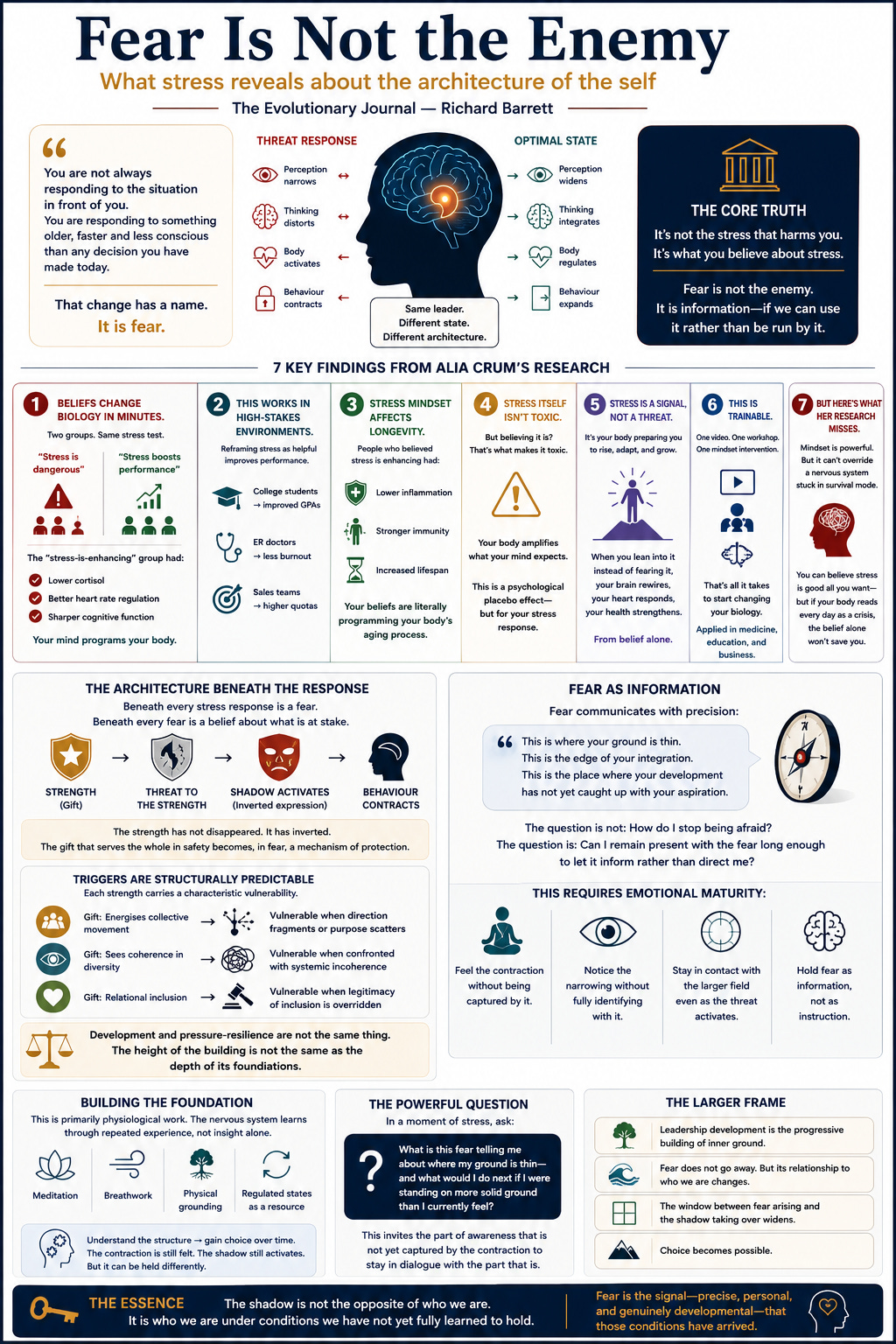
There is a moment that most leaders recognise but few speak about directly. It is the moment when you know — somewhere beneath the rational mind — that you are no longer responding to the situation in front of you. You are responding to something older, faster and less conscious than any decision you have made today.
Your voice has a different quality. Your listening narrows. Your field of perception contracts. You are still present — still articulate, still functional — but you are operating from a different place than the one you inhabit when conditions are settled. Something has changed in the architecture.
That change has a name. It is fear.
Not necessarily the acute fear of a specific threat. More often it is the quieter fear that underlies much of what we call stress: the fear of being wrong, of losing control, of not being enough, of the system unravelling, of others seeing what we cannot afford to show. This is the fear that does not announce itself. It organises behaviour from below the threshold of awareness, shaping decisions, distorting communication, narrowing the range of what feels possible.
Understanding this is not optional for leaders who want to develop. It is foundational.
What fear actually does
Fear is a biological response, not a character flaw. Its architecture predates the neocortex by hundreds of millions of years. When the nervous system detects threat — real or perceived, physical or social, immediate or anticipated — it activates a cascade of changes designed for one purpose: survival. Perception narrows to the relevant threat. Thinking accelerates in some dimensions and slows in others. The body prepares for action.
This is sophisticated engineering. In conditions of genuine danger, it saves lives.
The problem is that the nervous system cannot reliably distinguish between the threat of physical harm and the threat of social exposure. Being challenged in a meeting activates many of the same physiological processes as being confronted by a predator. The shame of being seen to not know something triggers a stress response as real, in nervous system terms, as a warning signal in a dangerous environment.
So leaders spend a great deal of their working lives in varying states of low-grade physiological activation — not because their situations are genuinely dangerous, but because the nervous system is responding to social and psychological threats as if they were existential ones.
The consequences are predictable and structural. Cognitive flexibility reduces — the ability to hold multiple perspectives, to consider long-range consequences, to sit with uncertainty and allow it to inform better judgment. Empathy narrows — the capacity to genuinely receive another person’s reality is the first casualty of a nervous system under threat. Creativity contracts. The already-integrated returns most reliably; the developmental frontier becomes temporarily unavailable.
This is what stress does. It does not simply make us feel worse. It makes us less than we are.
The structure beneath the response
Most approaches to stress management focus on the symptom: the elevated heart rate, the disturbed sleep, the shortened fuse. These are real and worth attending to. But they are not the architecture.
Beneath every stress response is a fear, and beneath every fear is a belief about what is at stake. That belief is rarely examined, because it operates faster than conscious reflection. It is part of what I call the Shadow — the distorted expression of our genuine strengths when fear has taken the wheel.
Every real strength has a shadow. The leader who builds consensus and holds diverse voices together — at their best, this is a genuine gift. Under sustained pressure, the same leader may become conflict-avoidant, withholding clarity to preserve harmony, softening truth until it loses its edge. The strength has not disappeared. It has inverted. The gift that serves the whole in conditions of safety becomes, in conditions of fear, a mechanism of protection.
This is not hypocrisy or weakness. It is the predictable structural response of a developed quality meeting the limits of its psychological foundation. When the ground is insufficient to sustain the full expression of who we are, the expression narrows to what the ground can hold. Fear is the signal that the ground is being tested.
The strategic leader who narrows to micromanagement under pressure. The visionary who retreats into abstraction when the immediate situation becomes too charged. The compassionate listener who suddenly becomes cold and procedural when their own authority feels threatened. In every case, the strength is still present somewhere — but fear has reorganised the system around protection, and the gift is no longer freely available.
What triggers the shadow
The triggers are not random. They are structurally predictable, because each person’s shadow is the inverted expression of their particular strengths — and those strengths carry within them their own characteristic vulnerabilities.
A leader whose greatest gift is the capacity to energise collective movement is most vulnerable when the direction fragments — when the shared purpose they have staked their sense of meaning on begins to scatter. A leader whose deepest quality is the capacity to hold diverse perspectives and perceive underlying coherence is most vulnerable when confronted with systemic incoherence that cannot be resolved within the time and resources available. A leader whose primary gift is relational inclusion is most vulnerable when the legitimacy of the inclusive process is overridden by authority acting unilaterally.
In each case, the trigger is not a general stressor. It is the specific threat to the specific quality that most defines the person’s way of being. The more deeply developed the gift, the more the nervous system mobilises to protect it when it is threatened.
This is why the most developed leaders are not necessarily the most resilient under pressure. Development and pressure-resilience are not the same thing. A leader can carry genuinely sophisticated and far-reaching capacities whilst possessing a foundational nervous system stability that is not yet adequate to sustain those capacities when conditions are genuinely demanding. The height of the building is not the same as the depth of its foundations.
Fear as information
Here is where the understanding becomes developmental rather than merely diagnostic.
Fear is not simply the enemy of good leadership. It is, when examined rather than acted out or suppressed, one of the most precise instruments of self-knowledge available to us.
When fear activates — when the contraction begins, when the narrowing is felt, when the shadow starts to organise behaviour — something important is being communicated. Not just that conditions are threatening. That information is crude and already known. What fear communicates with more precision is: this is where your ground is thin. This is the edge of your integration. This is the place where your development has not yet caught up with your aspiration.
The leader who becomes controlling under pressure has not discovered that they are a controlling person. They have discovered that their nervous system, at this depth of development, cannot sustain the trust required by the leadership they are committed to when the situation is genuinely demanding. That is specific, developmentally useful information.
The question is not: how do I stop being afraid? That question misunderstands the architecture. Fear will arise. It is part of the system. The question is: can I remain present with the fear long enough to let it inform rather than direct me?
This requires something that is genuinely developmental — not a technique, but a capacity. The capacity to feel the contraction without being captured by it. To notice the narrowing of perception without fully identifying with what it is producing. To remain, in some part of awareness, in contact with the larger field of the situation even as the nervous system is insisting that the threat in front of you requires immediate and total attention.
This is what we mean by emotional maturity in a developmental sense. Not the absence of fear. Not its suppression. The capacity to hold it — to feel it without being run by it, to use the information it contains without being reorganised by the protection it is instinctively offering.
Building the foundation
The practical work here is not primarily psychological. It is physiological. The nervous system learns through repeated experience, not through cognitive insight alone.
This means that the development of greater pressure-resilience — the capacity to remain more fully oneself when conditions are demanding — requires practices that work at the level of the body: meditation, breathwork, physical grounding, the deliberate cultivation of regulated states as a reliable resource. Understanding the architecture of fear intellectually does not change the speed of the nervous system’s response. Only practice does.
But the intellectual understanding matters too, for a different reason. When leaders understand the structure — when they can see that what is happening under pressure is not a revelation of who they really are but a temporary narrowing of what they can access — they gain choice. Not immediately, not automatically, but progressively. The contraction is still felt. The shadow still activates. But it can be held differently when it is understood rather than simply lived from.
The most powerful question a leader can bring to a moment of stress is not: what do I need to do right now? That question, asked from within the activation, simply accelerates the shadow. The more developmental question is: what is this fear telling me about where my ground is thin — and what would I do next if I were standing on more solid ground than I currently feel?
That question does not dissolve the fear. It does something more useful. It invites the part of awareness that is not yet fully captured by the contraction to remain in dialogue with the part that is.
The larger frame
Leadership development, understood in this way, is not primarily the acquisition of new skills. It is the progressive building of the inner ground through which increasingly sophisticated capacities can be expressed under increasingly demanding conditions.
Fear does not go away as development deepens. But its relationship to who we are changes. In the early stages of development, fear is the primary organiser of behaviour — we spend enormous energy managing it, suppressing it, performing around it. As development deepens, fear becomes more like information and less like instruction. It still arises. It still contracts the nervous system. But the window between the fear arising and the shadow taking over widens, and in that window, choice becomes possible.
The shadow is not the opposite of who we are. It is who we are under conditions we have not yet fully learned to hold. And fear is the signal — precise, personal, and if we can learn to read it rather than simply react to it, genuinely developmental — that those conditions have arrived.
This is not comfortable work. But it is the work. And it is, in the end, the work that most distinguishes leaders who grow through difficulty from those who are merely shaped by it.
Powerful writing about the understanding of fear! I feel it and I get it!